Few parenting topics stir up stronger opinions than where a baby should sleep. Co-sleeping, room-sharing, crib in a nursery, floor beds—everyone seems to have a favorite (and a horror story about the others).
You’re Not Choosing a “Team,” You’re Choosing What Works Right Now
Here’s the truth: most families mix and match sleep arrangements over the first few years, depending on the child’s needs and the parents’ well-being. You’re not signing a lifetime contract when you choose one.
Let’s gently compare common options, with a focus on safety, real-life pros and cons, and how to protect your routines no matter where your child sleeps.
Option 1: Room-Sharing with a Bassinet or Crib
What it is: Baby sleeps in their own safe sleep space (bassinet, crib, or pack-and-play) in the same room as the parents.
Major health organizations recommend room-sharing (not bed-sharing) for at least the first 6 months, and ideally up to 1 year, as it’s associated with a reduced risk of SIDS when done safely.
Pros
- Safety: Aligns with most expert guidelines.
- Convenient at night: You can hear baby and respond quickly without walking across the house.
- Smooth transitions later: It’s easier (though not always easy!) to move from your room to their own room than from your bed to their crib.
Cons
- Disrupted sleep for everyone: You hear every grunt and wiggle; they may wake more if they sense you right there.
- Space challenges: Not every bedroom easily fits an extra sleep space.
Routine tips for room-sharing
- Use a small nightlight instead of bright overhead lights for feeds and changes.
- Keep white noise on to muffle small sounds.
- Still create a clear bedtime routine (even if it’s just 5–10 minutes) so your child learns the difference between night sleep and quick wake-ups.
Option 2: Co-Sleeping / Bed-Sharing
What it is: Baby sleeps on the same sleep surface as a parent.
This is common worldwide and often chosen for cultural, emotional, or practical reasons (like breastfeeding ease). At the same time, many health organizations advise against bed-sharing with infants due to increased risks, especially in unsafe setups.
If you are already bed-sharing or plan to, it’s crucial to make it as safe as possible.
Safety-first guidelines (often called the “Safe Sleep 7” and similar frameworks)
Safer bed-sharing is more likely when:
- Baby is full-term, healthy, and over 3 months old.
- Baby sleeps on their back, on a firm mattress, with no pillows or heavy blankets near their face.
- Parents are non-smokers, not under the influence of alcohol, drugs, certain medications, or extreme exhaustion.
- There are no gaps where baby could get trapped (between mattress and wall, etc.).
- Baby is the only child in the bed (no siblings) and not placed on a soft surface like a couch.
Always check current guidelines in your country, and discuss your plan with your pediatrician.
Pros
- Convenient for feeding, especially at night.
- More contact and closeness, which many parents and babies find regulating.
- May lead to more total sleep for some families, even if there are many small wake-ups.
Cons
- Safety concerns, especially if conditions aren’t ideal.
- Harder to change later if it stops working for you.
- Parents may sleep more lightly or not as restfully.
Routine tips for co-sleeping
- Still have a mini-routine before bringing baby into bed: pajamas, dim lights, song, feed.
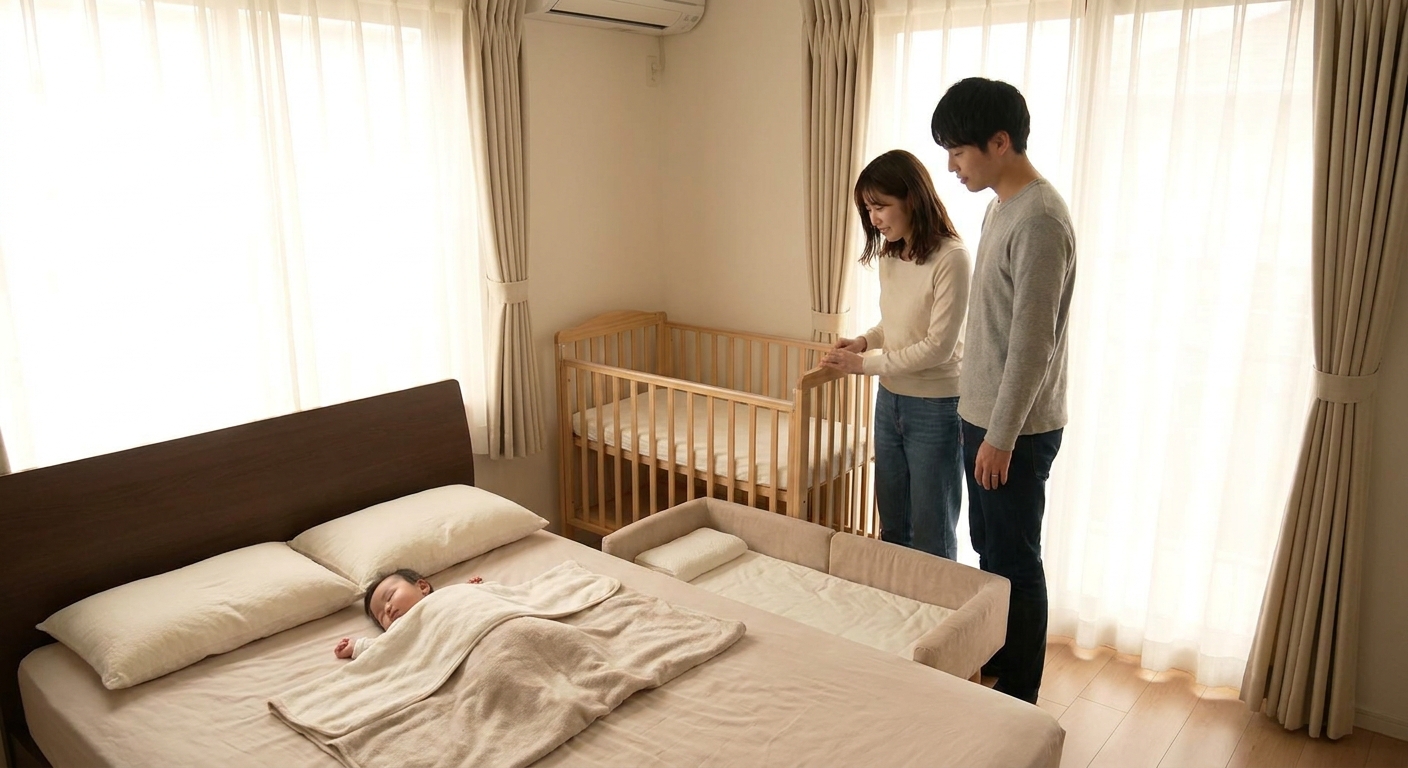
- Consider a sidecar crib (crib with a removed side next to your bed) to give baby their own firm space while preserving closeness.
Option 3: Crib in a Separate Room
What it is: Baby or toddler sleeps in their own room, in a crib or other safe sleep space.
Many families move to this setup once night feeds decrease or when everyone’s sleep is getting disrupted by room-sharing.
Pros
- Fewer disturbances from each other’s movements and noises.
- Clear physical cue that night is for sleeping.
- Easier to maintain a separate adult sleep and connection space, which can matter for your well-being.
Cons
- Feeds and comfort take more effort, especially at night.
- Some parents feel more anxious not having baby right next to them.
- Transitions can include protests or increased wakings for a bit.
Routine tips for crib-in-own-room
- Move one step at a time if you can: start with naps in the new room, or start the night there and bring them in with you after the first wake if needed.
- Keep bedtime routine identical whether they end up in your room later or not: same words, same songs, same stuffed animal (if age-appropriate).
Option 4: Floor Beds and Montessori-Inspired Setups
What it is: Instead of a crib, a toddler or older baby sleeps on a low mattress on the floor, often in a child-proofed room.
Many families use this approach around 12–18 months and up, when children are mobile and curious.
Pros
- Encourages independence: child can get in and out of bed on their own.
- Easier to lie next to them for comforting or story time.
- No crib-climbing safety worries later on.
Cons
- Nighttime wandering if the room (or house) isn’t fully child-proofed.
- Harder to contain an excited toddler at bedtime.
Routine tips for floor beds
- Make the room a safe sleep zone (outlet covers, furniture anchored, small objects removed).
- Use visual cues: a small rug or special pillow they sit on for book time; then they move to the bed for sleep.
- Consider a baby gate at the bedroom door if needed for safety.
How Sleep Routines Fit into Any Setup
No matter where your child sleeps, routines do the same three jobs:
- Signal that sleep is coming.
- Help their body wind down.
- Provide connection so they can separate more easily.
A simple routine might be:
- Diaper or potty, pajamas
- Teeth (if age-appropriate)
- 1–2 books
- Song, cuddles, or feeding
- A consistent “sleep phrase” (e.g., “It’s sleepy time. I’m right here.”)
You can use this routine in your room, their room, your bed, their bed, a hotel, or grandma’s house. The environment changes; the steps stay familiar.
Switching Sleep Arrangements Without Starting from Scratch
Life changes—someone goes back to work, a new baby arrives, your back hurts from bed-sharing, or your toddler starts climbing out of the crib.
You’re allowed to change your mind.
A gentle 4-step transition plan
- Talk about it (for older toddlers/preschoolers).
“You’re getting a big-kid bed! We’ll still do stories and songs, and I’ll still check on you.”
- Start small.
- Try the new sleep space for naps first, or
- Start the night there and bring them to you after the first wake if needed.
- Stay close at first.
Sit next to the crib or bed, patting or holding a hand as they fall asleep. Gradually move farther over days or weeks.
- Keep everything else the same.
Same routine, same sleep phrase, same comfort item (if age-appropriate). Familiarity = safety.
Listening to Your Gut (and Your Limits)
Here’s what matters more than picking the “right” option:
- Your child is as safe as possible.
- You are coping. If a setup leaves you resentful, in pain, or profoundly exhausted, it’s okay to adjust.
- You feel comfortable, not coerced. No method or arrangement is worth it if it goes against your instincts or circumstances.
Your family’s ideal sleep setup may not look like your friend’s—or the latest post you saw online. That’s okay. Being a loving, responsive parent isn’t about following one script; it’s about tuning into your child and your reality.
One Last Reassurance
If your current arrangement feels messy—baby sometimes in the crib, sometimes in your bed, sometimes on your chest—you haven’t “ruined” anything.
Sleep in early childhood is a series of phases, not a permanent report card.
You can:
- Make tonight as safe and calm as possible.
- Choose one small, gentle change if you want more rest.
- Revisit and revise as your child grows.
Whatever space your child sleeps in, the most important thing they feel is your love and your effort to keep them safe. And you’re already doing that.