Getting kids outside sounds wonderful in theory…until you factor in sunscreen, shoes, snacks, and someone needing the bathroom again.
Fresh Air Without the Fuss
You don’t need epic hikes or elaborate scavenger hunts for outdoor time to “count.” This guide compares simple, low‑prep outdoor activities by age and season, so you can pick what works today—not in an ideal world.
What Makes an Outdoor Activity “Good Enough”?
For most families, a great outdoor activity is:
- Short and flexible (10 minutes is still worth it)
- Low‑prep (minimal gear or setup)
- Age‑appropriate (challenging, but not constant rescue missions)
- Doable in small spaces (yard, courtyard, park corner, even balcony)
You’re allowed to keep it simple. The goal isn’t perfection; it’s sunlight, movement, and moments of connection.
Ages 1–3: Exploring the World One Leaf at a Time
Toddlers don’t need complicated plans—they’re amazed by ants and puddles.
Option 1: Ground Explorer Walk
What it is: A very slow walk where your child sets the pace and stops to examine everything.
Best for:
- Sidewalks, quiet streets, courtyards
- Any season
- Zero prep
- Builds language as you name what you see: "yellow flower, rough rock, big truck"
- You may not get far at all; this is about the journey, not the distance.
Pros:
Cons:
Age tweak: For 1‑year‑olds, you might carry them part of the way and let them down in interesting spots.
Option 2: Water Play Station
What it is: A shallow basin or bucket with water, cups, and spoons.
Best for:
- Warm seasons
- Patios, balconies, small yards
- Engaging for a surprisingly long time
- Great sensory play and motor practice
- Requires close supervision
- Some splashing and wet clothes likely
Pros:
Cons:
Quick tip: Put your toddler in clothes you don’t mind getting wet and use a towel or mat underneath.
Option 3: Nature “Kitchen”
What it is: A patch of dirt, sand, or grass plus containers and sticks.
Pros:
- Sparks pretend play: “soup,” “cakes,” “potions”
- Uses things you already have
- Dirt happens. A quick post‑play hand wash is your friend.
Cons:
Ages 4–6: Big Energy, Big Imaginations
Preschoolers and kindergartners love having a job or a mission.
Option 1: Color Hunt
What it is: Find items outside that match a few colors.
How:
- Name or show 3–5 colors.
- Invite: "Let’s find something green, something yellow, and something brown."
- Parks, yards, any green space
- Spring and summer (more colors), but works year‑round
- Easy to adapt: add more colors for older kids
- Builds observation skills and vocabulary
- Can feel “done” quickly; great as a warm‑up activity
Best for:
Pros:
Cons:
Option 2: Shadow Tag
What it is: Traditional tag, but you tap each other’s shadows instead of bodies.
Best for:
- Sunny days
- Open spaces
- Lots of movement without too much rough contact
- Natural introduction to talking about light and shadows
- Tricky on very cloudy days
- May be too hard for much younger siblings
Pros:
Cons:
Option 3: Stick & Stone Construction Zone
What it is: Collect sticks, stones, and leaves to build roads, fairy houses, or animal homes.
Best for:
- Parks, yards, patches of nature
- All seasons (even winter, with snow added!)
- Deeply creative and open‑ended
- Mixes imagination with hands‑on building
- Some kids may need a starting idea ("Can you make a house for this pinecone?")
Pros:
Cons:
Ages 7–9: Adventure, Autonomy, and a Bit of Challenge
Early elementary kids often crave a sense of capability. Outdoor activities can quietly build that.
Option 1: Micro‑Explorer Missions
What it is: Give one small “research task” each time you go out.
Examples:
- Count how many different bird sounds you hear
- Sketch one interesting plant or rock
- Time how long it takes to walk around the block
- Walkable neighborhoods, parks
- All seasons
- Adds purpose to everyday walks
- Encourages observation and curiosity
- Some kids may resist if it feels like homework; keep tasks light and playful.
Best for:
Pros:
Cons:
Option 2: Simple Obstacle Course
Use what’s around:
- Jump over cracks
- Balance on a curb
- Run to the tree and back
Let your child help design the course.
Pros:
- Great energy outlet
- Builds coordination and confidence
- Needs some space and safety checks (dry ground, no sharp edges)
Cons:
Option 3: Photo or Sketch Safari
Give your child a camera (or your phone, with limits) or a notebook.
Invite them to capture:
- 5 tiny things
- 3 big things
- 1 thing they’ve never noticed before
- Helps them see the familiar in new ways
- Quiet, mindful focus if your child tends to be anxious
- Requires a bit more time and patience
Pros:
Cons:
Seasonal Swaps: Same Idea, Different Weather
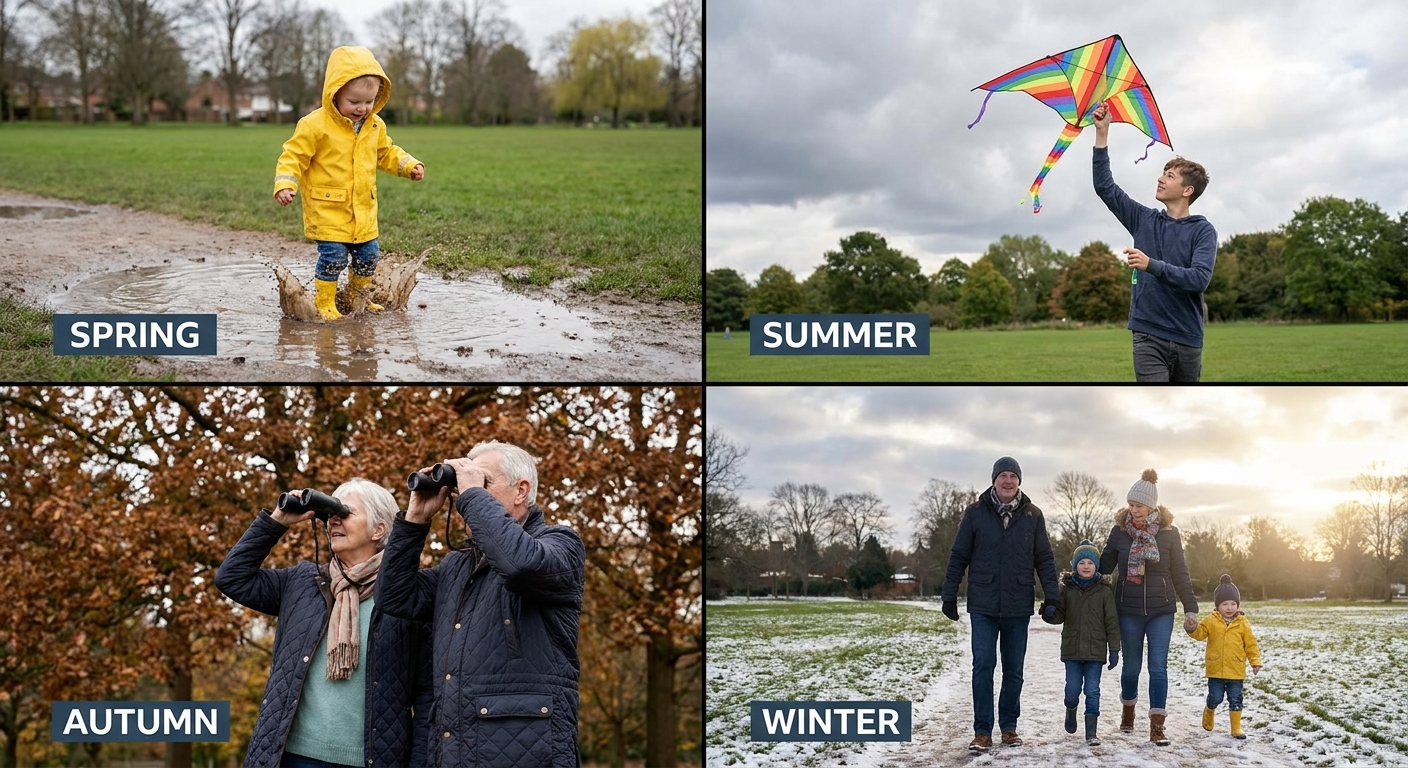
You can reuse the same basic activity idea all year with small tweaks.
Scavenger Hunts by Season
Spring:
- Something growing
- Something muddy
- A bug
- Something that makes shade
- Something that feels rough
- A flying insect or bird
- A crunchy leaf
- Something orange or red
- A seed or acorn
- Something frozen (if safe)
- Your breath in the cold air
- An animal track or bird in a tree
Summer:
Autumn:
Winter:
The structure stays the same; the details change with the season.
Tiny Spaces, Big Benefits
No yard? You can still get meaningful outdoor time.
Balcony or Small Patio
- Container digging: potting soil in a bin with spoons and cups
- Leaf art: collect a few leaves on walks and do rubbings outside
- Bubble play: blow and chase bubbles in a contained space
City Sidewalks and Courtyards
- Vehicle spotting: count buses, bikes, and cars
- Shape hunt: find circles, triangles, and rectangles in signs and buildings
- Speed walk vs. slow walk: take turns choosing the pace
Short, regular bursts of outdoor time add up—even if it’s just 15 minutes after dinner.
Matching Activity Types to Your Energy Level
Some days you’re ready to run; other days, you’re barely holding it together. That’s okay.
High-Energy You
- Obstacle courses
- Tag games
- Races and relay games
Low-Energy You
- Ground explorer walks (they move, you stroll)
- Nature kitchen (you sit nearby)
- Sketch or photo safari (you observe)
Let your own capacity guide the choice. Kids benefit from any time outdoors with you, not just the energetic versions.
Safety, Without Panic
A few simple guidelines help everyone stay safer outside:
- Review boundaries: "You can go as far as that tree/bench/fence."
- Teach simple check‑ins: wave or shout "check!" every few minutes at the park.
- Do quick environment scans: broken glass, loose dogs, slick surfaces.
You don’t have to hover constantly, but staying mentally present (not lost in your phone the whole time) helps you catch issues early.
Remember: Outdoor Time Doesn’t Need to Be Instagram-Worthy
Your child won’t remember whether the activity was “original” or photo‑ready. They’ll remember:
- Kicking leaves together on a dark fall afternoon
- Jumping over sidewalk cracks while you laughed
- That you sat on the steps and watched them pour water from cup to cup—for the hundredth time
- One slow walk at toddler pace,
- Ten minutes of color hunting at the park,
- Or a balcony bubble session before bath,
If all you manage this week is:
…you’re doing exactly what you need to.
Fresh air, a bit of movement, and your warm presence—those are the real essentials. Everything else is optional.